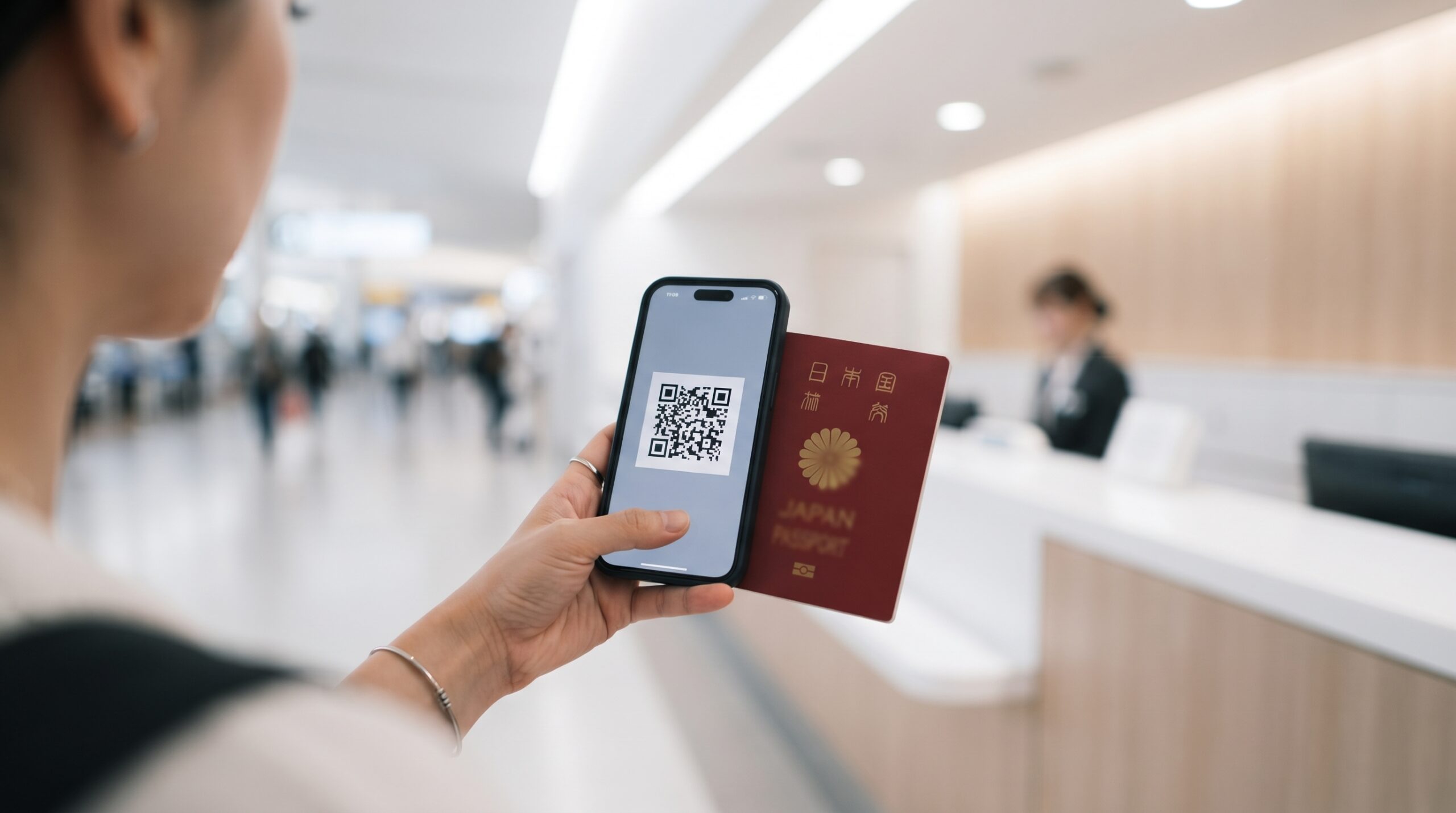
From 1 November 2026, buying tax-free in Japan no longer finishes at the till. You pay the full, tax-included price in the shop, and the consumption tax comes back to you only after Customs at the airport confirms the goods are actually leaving the country.
That moves the entire risk to departure day. And there is one step where most people are going to lose the money: their luggage.
This is the departure-day half of the guide. If you have not read it yet, the first part covers who qualifies and what happens in the shop.
Why Japan changed the system
Under the old rules the exemption applied at the register, before anyone had checked whether the goods left Japan. Ministry of Finance material describes what happened next: tax-free goods resold domestically. Even when Customs caught bulk buyers at departure, there was nothing to recover — the merchandise had already been moved on.
The refund model simply reverses the order. You pay, then you prove, then you are paid back.
The one rule that decides everything
Do your tax-free procedure before you check your bags.
The tax-free terminals sit in the international departure lobby, in front of the check-in counters. Once your suitcase is on the belt, Customs cannot inspect what is inside it, you cannot get it back, and your refund is gone. Not reduced — gone.
The practical consequence is that everything you bought tax-free has to stay with you as hand luggage until the procedure is finished. If you shopped seriously, pack a foldable extra bag for the trip home.
The four steps at the airport
- Find the tax-free terminal in the international departure lobby — before the check-in counters.
- Scan your passport. This part takes seconds.
- The screen returns green (no inspection needed) or red (take your goods to the Customs inspection counter).
- Only then check in and drop your bags.
At Narita, Haneda, Kansai, Chubu Centrair, Fukuoka, New Chitose and Naha you can also run the procedure through Visit Japan Web on the airport wi-fi. Two caveats: you can only do it once you are at the airport, and it still has to happen before security. There is no way to finish this from your hotel the night before.
What a red result actually involves
You present the goods listed on the receipt. All of them.
If one item is missing — used, given away, already packed in the hold — the entire receipt is disqualified, not just that item. This is the detail that catches people out most often.
Anything with a per-item tax-free value above ¥1,000,000 may also need a certificate of authenticity or a warranty card, so keep the paperwork that came in the box.
Plan on being inspected. Treat the green result as a bonus and get to the airport earlier than you otherwise would — a queue at the Customs counter is the one delay you cannot negotiate your way out of.
How you actually get the money
The refund comes from the shop, or from the refund agent that shop uses. It does not come from the government and it does not come from Customs — Customs only confirms the export. That means the method is set by the retailer, and it varies.
| Refund method | If you do not live in Japan |
|---|---|
| Credit card | Works. The safest default. |
| Cash at the airport | Works, and it is finished on the spot. |
| App transfer | Depends entirely on the app. |
| Japanese bank transfer | No — you need a Japanese account. |
You will not get back the full 10%. Refund operators and the larger department stores typically deduct a handling fee of roughly 1.55% to 2.2%, so on general goods the amount that reaches you is closer to 8.45% than 10%. Some retailers also settle in store points or vouchers rather than money.
Three questions to ask at the till, before you pay:
- Do you refund to a credit card?
- How long does the refund take?
- What is the handling fee?
And bear in mind that you are fronting the tax. If a purchase only fits your budget at the tax-free price, it does not fit your budget.
Seven ways to lose the refund
- Doing the procedure after checking your bags. The single most common way this goes wrong.
- One item missing from a multi-item receipt. The whole receipt fails.
- Opening and using consumables in Japan. If you did, go to a staffed Customs window and declare it rather than using the automated terminal. Declaring is fine. Concealing it is fraud.
- Leaving Japan more than 90 days after the purchase date. The window runs from the date on the receipt.
- Giving the goods to someone in Japan, or sending them on separately. They have to leave with you.
- Buying more than you can plausibly carry yourself. The allowance is personal-use quantities.
- Not exporting the goods at all. That gets you assessed for the consumption tax, plus penalties.
Special cases
Domestic connection before your international flight
Do the procedure at the last airport you depart Japan from, not the first one you fly out of.
Leaving by cruise ship
For an international sailing, handle it at the final Japanese port before you hand over your baggage. For a fly-and-cruise package, do it at the airport you fly out of.
Shipping purchases home separately
Refunds on separately shipped goods ended on 1 April 2025. Some retailers still offer international shipping on their own terms, but that is a commercial arrangement, not a tax-free one — ask before you buy rather than after.
Things that are never eligible
Gold and platinum bullion are excluded outright. One piece of good news, though: from 1 November the sealed-bag requirement for consumables disappears, and so does the separate treatment of consumables and general goods — including the ¥500,000 ceiling that used to apply to consumables. The minimum is still ¥5,000 before tax, per shop, per day.
If you have claimed VAT back elsewhere
Japan’s new system is a hybrid. Paying full price up front is the European pattern; verifying at a kiosk on the way out is the Asia-Pacific one. What Japan does not have, from 1 November, is any form of in-store refund.
| Country | Minimum spend | Where you claim |
|---|---|---|
| Japan (from 1 Nov 2026) | ¥5,000 before tax, per shop per day | Airport terminal, before baggage check-in |
| South Korea | ₩15,000 per receipt | Immediate in-store refund, or airport kiosks |
| Taiwan | NT$2,000 same shop, same day | Partly in-store, plus airport e-VAT |
| Singapore | S$100 including tax | Airport eTRS kiosks |
| Australia | A$300 including tax, same vendor | Airport TRS counter; card or Australian account |
| France | €100 same retail chain | PABLO terminals; refund arrives later, minus fees |
If you are used to Korea or Taiwan, the thing to unlearn is the in-store refund — it does not exist in Japan under the new rules. If you are used to Australia, note that its 30-minute pre-departure cutoff has no Japanese equivalent, but arriving late still means missing the counter.
Your departure day, in order
- Get to the airport earlier than you normally would.
- Keep every tax-free purchase with you — nothing in the hold yet.
- Scan your passport at the tax-free terminal in the departure lobby.
- If the result is red, go to Customs inspection with the goods.
- Now check in and drop your bags.
- Security, then your flight.
One phrase covers it: tax-free before checked bags.
Frequently asked
Can I complete the procedure before I get to the airport?
No. Visit Japan Web can carry your details, but the tax-free step itself happens at the airport, before security, on the day you fly.
I already checked my bag. Can anything be done?
Not for the items inside it. Customs cannot verify goods it cannot see, and baggage handling cannot be stopped on request. Anything still in your hand luggage can go through normally.
Do I get the full 10% back?
Usually not. Handling fees of around 1.55% to 2.2% are common, which puts the real figure nearer 8.45% on general goods. Food and drink are taxed at 8% to begin with, so the refund there is smaller again.
I opened the snacks. Now what?
Use a staffed Customs window rather than the automated terminal and say so. You will lose the refund on that receipt, but declaring it is the correct move — the alternative is treated as fraud.
Do I still need the sealed bags?
Not from 1 November 2026. The special sealed packaging for consumables is abolished, along with the general-goods / consumables split.
A note on timing
Until 31 October 2026 the old system still applies: the tax comes off at the register and there is nothing to do at the airport. If your trip straddles the change, the date on the receipt is what decides which set of rules you are under.
コメント