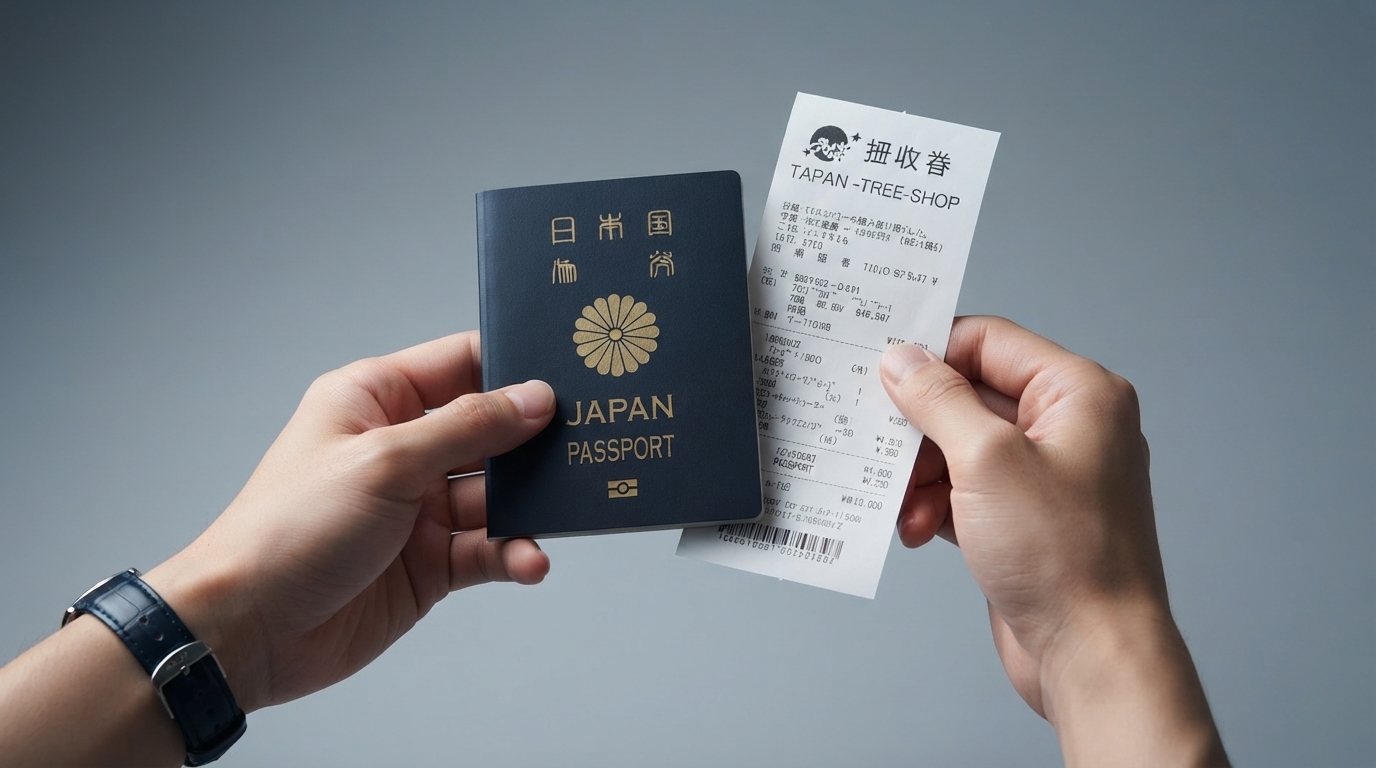
1. The short version: from 1 November 2026, you pay the tax first
Japan’s tax-free system for visitors (officially the export goods sales place system) moves to a refund model on 1 November 2026.
In one line:
- Until now — you paid the tax-excluded price at the till. The exemption was settled the moment you bought the item.
- From now on — you pay the full tax-included price at the till, show your goods to Customs at the airport when you leave, and the consumption tax is refunded to you afterwards.
The place where your exemption is finalised moves from the shop counter to the departure airport.
For you as a shopper, the biggest practical change is this: you have to front the tax. A ¥200,000 camera now costs you ¥220,000 on the day, with ¥20,000 coming back later. If you are planning a big shopping day, check your card limit before you go.
Quick comparison
| Until 31 Oct 2026 | From 1 Nov 2026 | |
|---|---|---|
| What you pay at the till | Tax-excluded price | Tax-included price, refunded later |
| When the exemption is final | At the till | After Customs check at the airport |
| Minimum purchase | ¥5,000 (pre-tax) | ¥5,000 (pre-tax), single unified rule |
| Cap on consumables | ¥500,000 | No cap |
| “General goods” vs “consumables” | Two separate categories | Abolished |
| Sealed bags for consumables | Required; cannot open in Japan | Sealed bags abolished — but consuming the goods in Japan still voids the refund |
| Deadline | Shop within 6 months of entering Japan | Same, plus Customs check within 90 days of purchase |
Which section applies to you
- Travelling and shopping on or before 31 October 2026 → read Section 4.
- Shopping on or after 1 November 2026 → read Section 5.
- Everyone → read Sections 2 and 3 first. Eligibility and documents have not become easier, and this is where most people get turned away.
2. Do you actually qualify? Three conditions
Tax-free shopping in Japan is for non-residents. Three things have to be true at the same time.
Condition 1 — You are a non-resident of Japan
You must not have a base of living in Japan. For a visitor arriving on a tourist trip, this is normally satisfied automatically by your status of residence (Condition 3).
If you have lived in Japan before and have since moved abroad, you qualify once you have been living outside Japan for two years or more.
Condition 2 — You entered Japan less than 6 months ago
Stay in Japan for six months or longer and you are treated as a resident, and tax-free shopping stops being available to you.
For most tourists this never binds — a Temporary Visitor permission runs to 90 days at most. It matters if you are on a Diplomat or Official status, or if you are a returning former resident on an extended family stay. If that is you, do your shopping well inside the six-month window.
Condition 3 — Your status of residence
If you are a foreign national, your status of residence must be one of:
- Temporary Visitor (短期滞在) — the status almost all tourists and short business travellers hold
- Diplomat (外交)
- Official (公用)
You do not qualify on a working or living status — Permanent Resident, Spouse of a Japanese National, Engineer/Specialist in Humanities, Student and so on. Living and working in Japan means you are a resident, regardless of your nationality or how long your visa runs.
A note if you are a Japanese national living abroad, or a former resident of Japan. You qualify under the same non-resident logic, but you prove it with different paperwork — a Certificate of Residence Abroad from your local Japanese embassy, a copy of the family register supplementary record (koseki no fuhyo), or an overseas-resident My Number Card. Details are in Section 3b.
3. What you show at the shop
3a. If you are a visiting foreign national: your passport
Bring your actual passport — not a photo, not a photocopy, not a hotel-desk scan. Staff need to read two things from it:
- Your status of residence — Temporary Visitor, Diplomat or Official.
- Your date of entry into Japan — to confirm you are inside the six-month window.
Both normally come from the landing permission seal stamped into your passport at immigration.
Good news: as an ordinary short-term visitor you are processed at a staffed immigration booth and that seal is applied as a matter of course. This is not something you need to manage. (Japan’s automated and face-recognition gates on arrival are for Japanese nationals, residents re-entering, and Trusted Traveler members — not for tourists.)
Two narrow exceptions, where no seal is applied:
- Trusted Traveler Program members — your Specified Registered User Card serves instead.
- Cruise ship arrivals — your landing permission document for cruise passengers (船舶観光上陸許可書) serves instead.
Carry whichever applies alongside your passport. If you see warnings online about automated gates and missing stamps, they are aimed at Japanese nationals returning home and at foreign residents re-entering on a residence card — see Section 3b, where this is a genuine and expensive problem.
You also have to do the procedure in person. A family member cannot present your passport and buy on your behalf.
3b. If you are a Japanese national or a former resident living abroad
From 1 November 2026, one of the following originals is required:
| Document | Where you get it | How long it takes | Best for |
|---|---|---|---|
| My Number Card for overseas residents (with the overseas-transfer notation) | Japanese embassy/consulate abroad, or online | Around two months, plus a personal visit to collect it | Anyone with time before the next trip. One-off effort, reusable on every future visit |
| Certificate of Residence Abroad (在留証明) | Japanese embassy/consulate in your country of residence | Same day to a few days | Trips booked at short notice. Must be obtained before you fly |
| Copy of the family register supplementary record (戸籍の附票の写し) | The municipal office of your registered domicile in Japan | 1–2 weeks by post | People whose registered domicile is easy to reach. Usually the cheapest |
Rules that apply to all three:
- Originals only. Copies, photos and scans are rejected.
- The certificate or record must have been issued within 6 months before your date of entry into Japan — so the certificate route means getting it before you fly, not after you land.
- Substitutes are not accepted: residence card, family register itself, driving licence, local ID card.
- You must handle it yourself; a family member cannot do it for you.
- The document has to show that two years or more have already elapsed abroad. You are legally a non-resident from the day you leave Japan intending to stay two years or more, but in practice a first-year expat cannot produce a document a shop can accept.
- Your passport entry stamp is still required on top of the document above. The document proves you live abroad; the stamp proves you entered less than six months ago.
The most common failure, and it is unfixable. Japanese nationals and re-entering residents are routed through automated and face-recognition gates, and those gates do not stamp your passport. No stamp means the shop cannot confirm your entry date, and it will refuse the procedure — however perfect your documents are. Use a staffed immigration counter, or, if you have already gone through a gate, ask staff at the immigration office for a stamp before you clear Customs and leave the arrivals hall. Once you are out of the airport, it cannot be added later.
One piece of good news: from 1 November 2026 the registered domicile no longer has to appear on these documents. Until 31 October 2026 the family register record must still show the domicile down to the lot number, un-redacted and unabridged — ask the counter staff not to abbreviate it, or the shop will turn you away.
4. Buying tax-free up to 31 October 2026 (the current system)
Two categories
| Category | Typical items | Amount | Packaging |
|---|---|---|---|
| General goods | Electronics, bags, shoes, clothing, kimono, watches, jewellery, folk crafts | ¥5,000 or more, pre-tax | Normal packaging. You may use them in Japan |
| Consumables | Food, cosmetics, drinks, medicines, fruit | ¥5,000 to ¥500,000, pre-tax | Sealed in a designated bag. Cannot be opened in Japan |
How the ¥5,000 is counted
- Judged on the tax-excluded price.
- Purchases in the same shop on the same day can be combined, so you do not need a single ¥5,000 item.
- Many department stores let you pool purchases from different floors and counters in one building.
- The ¥500,000 consumables cap is per shop per day, so splitting across shops was always an option. In practice, few travellers ever hit it.
At the till
- Shop somewhere displaying the “Japan. Tax-free Shop” logo.
- Take your goods, passport and documents to the tax-free counter (or a till that handles it) yourself.
- Staff check your entry stamp and documents.
- You pay the tax-excluded price. Consumables are sealed into their bag.
- The purchase record is transmitted electronically to the National Tax Agency — nothing is stapled into your passport any more.
5. Buying tax-free from 1 November 2026 (the refund system)
Step 1 — In the shop: you pay the full price
The till shows the tax-included price and that is what you pay. There is no discount at the counter. You still present your passport and documents, and the shop still creates an electronic purchase record — it just does not reduce what you hand over that day.
The genuine improvements show up here: the general/consumables split is gone, there is no upper limit, and consumables are no longer sealed into a designated bag.
But do not misread the packaging change. The sealed bag is gone; the rule it enforced is not. Consumables still must not be eaten, drunk or used up in Japan. Anything you have consumed cannot be shown to Customs on departure — and under the rule below, it takes the rest of that purchase record down with it.
Excluded goods. Gold and platinum bullion, precious-metal coins and non-taxable items are outside the system entirely. Worth knowing before a high-value purchase.
Step 2 — At the airport: Customs confirmation, within 90 days of purchase
On your departure day, take the goods to the airport or seaport, go to a tax-free procedure terminal, present your passport, and receive the Customs confirmation. Only at this point does your exemption actually exist.
Three things to get right:
- Do it before you check your bags. The terminals are in the pre-check-in area. Once your suitcase is on the belt, you cannot complete the procedure for anything inside it.
- Within 90 days of the purchase date. A purchase early in a long trip can expire before you leave.
- Only what you can physically carry out counts — hand luggage and checked baggage you present. Anything left in Japan or sent by separate shipment does not.
Step 3 — The refund: how the money comes back
The tax is refunded by the tax-free shop or a refund operator acting on its behalf, based on the Customs confirmation data.
The Japan Tourism Agency lists these as possible methods: bank transfer, refund to your credit card, app-based transfer, and cash at the airport. That is a list of what is permitted, not a promise — each shop decides which it offers.
Ask at the till, before you pay: “How will I receive the refund?” If you have no Japanese bank account and the shop only does bank transfers, you will never see the money. In my view, a refund to the card you paid with is the least likely to go wrong.
The one rule that can wipe out a whole purchase
If even one item in a single purchase record cannot be verified at Customs, every item in that record loses its exemption — not just the missing one.
So these all cost you the entire refund for that receipt:
- Opening and using something up on the day you bought it
- Giving an item to family or friends in Japan
- Sending part of the purchase home by separate shipment
My own workaround: if you know an item is a gift for someone in Japan, buy it on a separate receipt that you never claim.
Who gains and who loses under the new system
Better off:
- Anyone buying cosmetics, supplements or food in bulk — the ¥500,000 cap is gone
- Big-ticket shoppers, now that the categories are unified
- Repeat visitors, once their documentation is sorted out
- Anyone who found the sealed-bag logistics awkward on a long trip
Worse off:
- Tight-schedule departures — the Customs step takes time you did not previously need
- Anyone on a low credit limit — you are fronting 10% of everything
- Gift-givers and separate-shipment shoppers — those items simply do not qualify
- Long trips — the 90-day purchase window and the 6-month entry window can both bite
6. Practical tactics
Where to shop efficiently
- Electronics chains — dedicated tax-free counters, staff who do this all day, fast for high-value items.
- Drugstores — cosmetics, medicines and supplements as standard. Expect queues in the evening in tourist districts.
- Department stores — the best option for reaching ¥5,000 by pooling purchases across floors.
- Discount superstores — food through to appliances in one transaction, which keeps your receipt count down.
How much actually comes back
Japan’s consumption tax is 10%, or 8% on food and non-alcoholic drinks. Rough numbers:
| You spend (pre-tax) | Refund at 10% | Refund at 8% (food & drink) |
|---|---|---|
| ¥50,000 | ¥5,000 | ¥4,000 |
| ¥100,000 | ¥10,000 | ¥8,000 |
| ¥300,000 | ¥30,000 | ¥24,000 |
| ¥500,000 | ¥50,000 | ¥40,000 |
Rates as of September 2026. Japan’s reduced rate on food has been the subject of active legislative debate — check the current rate before relying on these figures.
Worth the paperwork on a real shopping trip. Probably not worth reorganising your itinerary for a ¥6,000 purchase.
Budget the time
- Get to the airport earlier than you normally would. The Customs step is new for everyone, including the staff.
- Peak periods — New Year, Golden Week, the August Obon holiday — mean longer queues at the terminals.
- Again: tax-free procedure first, bag drop second. Getting this order wrong is the most expensive mistake available.
7. FAQ
Can I shop tax-free online? No. The procedure has to be done by you, in person, in a tax-free shop.
Can I buy for my whole family on one transaction? No. The purchase must be in your own name and handled by you. If family members travelling with you each qualify, each of them does their own procedure.
Can I give what I bought to friends or family in Japan? Tax-free goods are meant to leave the country with you. From 1 November 2026 in particular, anything you cannot show to Customs on departure is not refunded — and it takes the rest of that receipt down with it.
Can I ship purchases directly to my home address abroad? No. Tax-free shopping via separate postal shipment was abolished for purchases made from 1 April 2025. The goods have to leave with you as hand or checked baggage.
Where do I find tax-free shops? Look for the “Japan. Tax-free Shop” logo. Electronics retailers, department stores, drugstores and discount stores are the usual suspects.
Is the ¥5,000 threshold before or after tax? Before tax. Purchases at the same shop on the same day can be combined.
I’m a Japanese national living overseas — does my My Number Card work? Yes, if it is the overseas-resident version carrying the overseas-transfer notation; from 1 November 2026 it is accepted as a verification document. You still need the entry stamp in your passport.
What if I’ve been in Japan more than six months? You no longer qualify. Do your shopping inside the six-month window.
Checklist before you fly
- ☐ I qualify as a non-resident (Temporary Visitor / Diplomat / Official status, or 2+ years living abroad)
- ☐ My trip keeps me inside the 6-month window
- ☐ My passport has the landing permission seal — or, if TTP or cruise, I’m carrying the substitute document
- ☐ (Japanese nationals / former residents) My original document is in hand, issued within 6 months before entry, and I will get a passport stamp at a staffed counter
- ☐ I will shop within 90 days of my departure date
- ☐ I asked each shop how the refund is paid, and whether they can refund to my card
- ☐ Gifts for people in Japan go on a separate receipt
- ☐ Nothing I claim gets eaten, drunk or used up before I leave
- ☐ I’ve allowed extra time at the airport, and I’ll do the tax-free terminal before bag drop
Tax-free shopping in Japan rewards preparation and punishes improvisation. The two mistakes that cost people the most are both avoidable: checking your bags before you visit the Customs terminal, and opening the snacks. Neither of those is obvious until it has happened to you.
I’ll add a first-hand report of using the new system once I’ve been through it after 1 November 2026.
Related reading
- At the airport: how the tax-free Customs check and refund work from 1 November 2026 (Japanese)
- What to buy in Japan: recommendations, part 1 (Japanese)
Official sources
- National Tax Agency — Revision of the export goods sales place system to the refund method
- Japan Tourism Agency — Consumption tax-free shop site
- Japan Tourism Agency — Traveller information page (multilingual leaflets)
- Japan Duty Free Shop Association — “Refund Method” special site
- My Number Card portal — My Number Card for overseas residents
- Immigration Services Agency — On expanded use of face-recognition gates
Originally published 14 November 2023. Last updated 6 September 2026. English edition adapted for visitors to Japan.
コメント